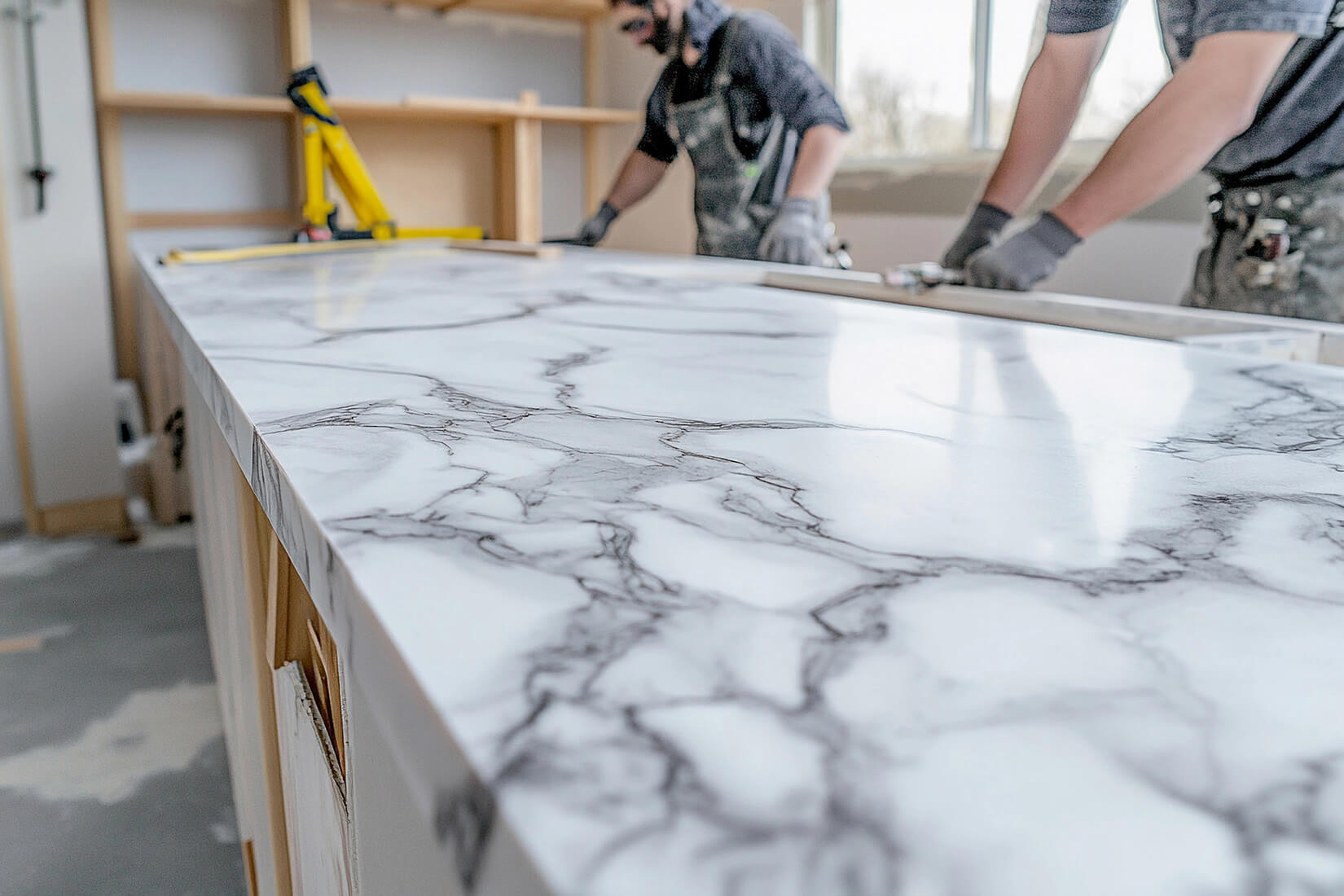
The old proverb says: “Measure twice, cut once.” At no time is that advice more profound than when measuring countertops. Some mistakes in life you can work around, but if your countertops are mismeasured, it will cost you time and money.
If you order marble, granite, or quartz countertops with incorrect countertop measurements, the slab may arrive too short or too narrow. At that point, the only option is to reorder the material, which will delay the entire installation.
In this article, we’ll share with you how to avoid common measuring mistakes so your countertops slide in place just right.
Planning a Kitchen or Bath Renovation in the Future?
Professional countertop installers know how to measure accurately to avoid mistakes, but if you’re tackling the renovation on your own, you may need to take extra care. If this sounds like you, you’re not alone because many others are in the same situation.
- Homeowners planning a kitchen or bath remodel soon.
- DIYers preparing to order and install their own countertops.
- Anyone who wants to avoid delays and measurement mistakes.
It’s time to pick up your measuring tape and get your remodel off on the right foot.
How to Measure Countertops Without Making These Costly Mistakes
It’s easier to make a mistake than to do it correctly when measuring for new countertops, especially if you’re not a professional. Before starting your kitchen or bath renovation, consider these potential mistakes to avoid.
Mistake #1: Not Getting Precise Measurements to the Nearest ⅛ inch
The standard tape measure is a DIYers best friend. The most common and easiest to use are the standard locking retractable tape measures and their counterparts, the fabric tape measures. Both measure down to ⅛”, which ensures accurate countertop measurements and makes them easily accessible around most homes.
Take your time when measuring and be specific. Write down each measurement as you go and keep any notes that might relate, such as if your kitchen isn’t plumb or if your cabinets slope up or down.
Mistake #2: Not Getting Accurate Measurements for the Base Cabinets First
Your solid surface countertops rest on the cabinets, so it makes sense to measure them first and follow these guidelines by measuring the following.
- The width: Measure the full width of each base cabinet along the wall from outer edge to outer edge, and label each measurement clearly.
- The depth: Measure from the back wall to the front edge of each base cabinet. Standard depth is about 24 inches, but always verify.
- The height: Measure the height of the cabinets from the floor to the top. The standard is 36 inches.
Mistake #3: Not Getting Accurate Measurements of the Countertop Surface
This is where you’re measuring for the size and shape of the actual countertop.
- The length: Measure each countertop run along the wall, including any sections that extend over cabinets or between walls. Be sure to note every connected section.
- The depth (including overhang): Take your measurement starting from the back wall to the front edge of the countertop, ensuring that the overhang is included in the measurement. A standard overhang is approximately 1.5 inches, but this measurement is different for every design or seating requirements.
- The overhang itself: Measure from the front face of the cabinet to the desired finished edge of the countertop. This confirms that you have sufficient space for seating, knee room, and extended work areas.
The countertop surface measurements are the heart of your project, so double-check each measurement and make a note of it.
Mistake #4: Not Accounting for Sinks, Cooktops, and Appliance Cutouts
You’ll need accurate measurements and instructions for cutouts to fit around sinks, cooktops, and other built-ins. Each one requires precise measurements. For example, what size is your sink? Is it a drop-in or farmhouse style? Most sink manufacturers provide cutout instructions, which can be found in the owner’s manual or on their website.
When it comes to cooktops, consult the manufacturer’s specifications for accurate information. However, in general, measure the outer dimensions of the cooktop to ensure the best fit.
Mistake #5: Not Calculating Total Square Footage Accurately
You might think that getting the measurements is enough, but there’s another step, and that’s calculating the total square footage of your slab. This determines how much countertop material you’ll need and how much it will cost. To get the precise amount, follow the easy directions below.
- Measure each section separately: Break your countertop space into rectangles or squares and measure each one individually.
- Use the correct formula: Multiply length × width for each section to get square inches, then divide by 144 to convert to square feet.
- Include islands, peninsulas, and extended overhangs: Don’t forget breakfast bars, waterfall returns, or any seating overhangs.
- Round up, not down: Small rounding errors add up quickly — always give yourself a little buffer.
Accurate square footage ensures you’re budgeting correctly and ordering the right amount of material from the start.
Mistake #6: Not Measuring the Countertop Edge Profile
DIYers often overlook measurements for the countertop edge, which is the shape or contour of the finished edge of the countertop. If you don’t order this, you’ll end up with a raw, unfinished edge. Edge profiles vary in shape and size, and several key considerations should be taken into account when measuring.
- Edge styles differ: Styles include eased, beveled, bullnose, ogee, and waterfall edges, each of which changes the finished dimension slightly.
- Ask your fabricator for specifications: Most shops have specific thickness requirements depending on the stone and edge style.
- Consider overhang changes: A deeper or decorative edge can increase the overall front-to-back measurement of the countertop.
- Match edges for connected pieces: Ensure that adjoining countertop sections use the same edge profile to maintain a consistent look.
Mistake #7: Not Accounting for Obstacles and Other Anomalies
In your final design diagram, you’ll need to add measurements for electrical outlets and countertop lighting, for example. Even a small bump-out in the wall or an outlet positioned too close to the surface can prevent the slab from sitting flush against the wall.
Level Up Your Kitchen Countertop Renovation Today
Measuring, ordering, and installing your own kitchen countertops is definitely doable on your own; however, the process will be less stressful and time-consuming with the help of a professional.
Kitchen and Bath by Design specializes in custom kitchen and bath renovations in Arvada and Littleton. You can visit our showroom to see the natural materials we use for our countertops firsthand. We also fabricate the slabs for your project on-site, according to your measurements.
Schedule an appointment online with one of our Arvada or Littleton-based design experts to discuss your vision, or call us at (720) 712-3659. We’re here to help you turn your dream of a beautiful kitchen or bath remodel into a reality.

Family-owned for 20+ years offering high-quality, in-house fabricated marble and granite countertops and offer a wide array of comprehensive full remodeling services tailored to meet your diverse renovation needs. Visit our showroom for full-service remodeling. Fully insured, bilingual, and committed to excellence.